AI in Education: The Classroom Transformation Nobody Has Figured Out Yet
The education system is being rewritten in real time — and the evidence is barely there
AI in education is one of the most consequential technology-and-society stories of the current cycle, and it is also one of the ones where the gap between the hype and the evidence is largest. The usage numbers are large and growing fast. The effectiveness numbers are thin, mixed, and in some cases actively cautionary. The honest summary is that the classroom is being changed by AI faster than anyone has figured out whether the changes are good, bad, or somewhere in between.
That is not a comfortable place to be for a sector that is, by definition, about building the capacities of the next generation. But it is the place we are in, and the data — as incomplete as it is — tells a story that is worth telling clearly.
The usage numbers are large and accelerating
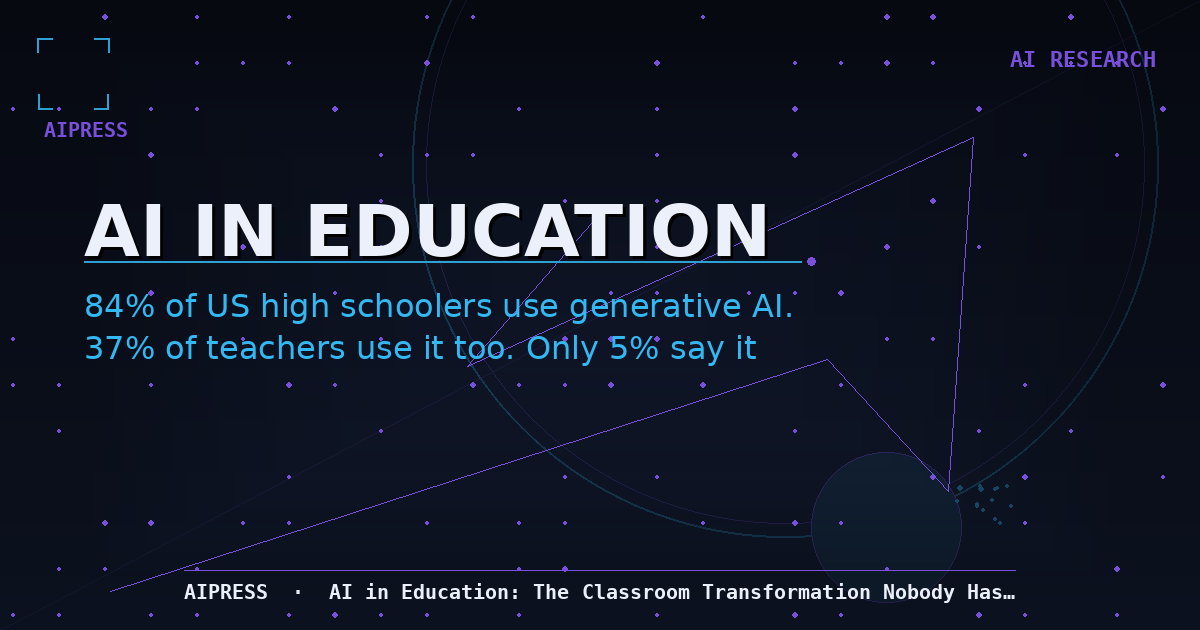
The most concrete signal comes from the College Board's research arm, which reported in October 2025 that the percentage of U.S. high school students who say they use generative AI tools for schoolwork had grown from 79% to 84% in the space of a few months — between January and the fall of 2025. An eight-point jump in a single academic year is a fast adoption curve for any technology, let alone one that is still poorly understood by the people using it.
That figure sits alongside a broader global picture. A longitudinal study published in 2025 in the ScienceDirect journal Technology in Society found that AI use for assessment preparation and studying had risen from 57% to 83% over the period studied, and use for studying specifically had risen from 44% to 76%. Those are large percentages that are moving in one direction: up.
The Higher Education Policy Institute's Student Generative AI Survey 2025, published in February 2025, found that 50% of UK university students reported using AI to improve the quality of their work — a use case that sits between "honest study aid" and "doing the work for you" and is, in practice, often both at once.
The Digital Education Council's AI in Higher Education Global Survey 2026 — a major annual benchmark — found a more ambivalent picture among the students who had actually experienced AI use in their courses: only 5% said it had transformed how they learn, and a further 28% said it enhanced their understanding. That is a much smaller "this is changing everything" number than the usage numbers would suggest, and it is a significant corrective to the most breathless versions of the AI-in-education narrative.
Teachers are using it too — at meaningful rates
The student-side numbers get most of the attention, but the teacher side is where the systemic question really lives. The OECD's 2024 Teaching and Learning International Survey — a large, rigorous, cross-country teacher survey — found that 37% of teachers already use generative AI for work-related tasks, such as learning about subject matter, preparing materials, or administrative work. That is a large share of the teaching workforce using a technology that most school systems have not formally adopted, trained them on, or set rules for.
The OECD's 2024 Education Policy Outlook, titled "Reshaping Teaching into a Thriving Profession: From ABCs to AI," flagged the same themes the teacher-survey numbers imply: rising teacher shortages, unequal access to technology, and an urgent need for policy reform to modernize education systems across the 33 OECD member countries. The AI-in-education conversation is happening inside a broader teacher-crisis conversation, and the two are not independent of each other.
A UNESCO framing of the same question — "Artificial Intelligence in Education" — put the tension in the most broadly useful way: AI has the potential to address some of the biggest challenges in education, innovate teaching and learning practices, and accelerate progress toward SDG 4 (quality education). But the rapid technological developments inevitably bring multiple risks and challenges that have so far outpaced the policy debates and regulatory frameworks meant to handle them. That gap — technology moving faster than policy — is the throughline of the entire education story.
The evidence on learning outcomes is thin and mixed
Here is where the story gets less clean and more important.
A Nature Humanities and Social Sciences Communications study published in March 2026 reviewed the ChatGPT effect on student learning outcomes and found a mixed picture: some positive effects on writing skills and motivation in controlled settings, but significant concerns about over-reliance, reduced critical thinking, and uneven benefits across student populations. The Song and Song 2023 study, included in that review, found that AI-assisted instruction significantly boosted students' writing skills and motivation over a 12-week period — a genuine positive result, in a specific context, for a specific skill.
But "did this in one study for one skill in one context" is a far cry from "improves learning," and the education literature does not yet have the large-scale, multi-year, multi-population evidence base that would let us say with confidence what AI is doing to learning outcomes overall.
The Stanford AI Hub for Education Research Repository, as of October 2025, contained a surprisingly limited body of evidence on how AI impacts K-12 students and educators — a finding that is striking given how much public attention the question has received. The 2026 Stanford review of the evidence base on AI in K-12 described the research as "extremely limited," which is a sobering adjective for a technology that is already in the hands of 84% of U.S. high school students.
The personalized learning literature is more developed but still bounded. A 2025 global systematic review in Results in Engineering examined AI in personalized learning across tertiary and higher education contexts, using the PRISMA 2020 framework across 25 Scopus-indexed articles published between 2019 and 2024. The review mapped publication trends and identified the promise of AI-driven adaptive content delivery and intelligent tutoring, but it was a literature mapping, not a causal evidence synthesis — the difference between "here is what people are studying" and "here is what we know works" matters.
A 2026 Frontiers in Education systematic review of AI and personalized learning in education found that the research priorities are shifting geographically — moving from the historically dominant China, U.S., and Europe toward broader Asia — which is a sign of a maturing field but also a reminder that the evidence base is still being built, not yet consolidated.
The homework-and-cheating dimension is only part of the story
The cheating dimension of AI in education — covered in the companion Gen Z piece in this series with the RAND 67% homework figure and the Pew trajectory from 13% to 26% to higher numbers — is the most visible part of the education story and the easiest to grasp. The assignment is written; the chatbot does it; the grade is earned; the learning is not.
But that is a subset of a larger question, which is what it does to the educational process when the tool that can do any specific cognitive task on command is available to every student in the room. The RAND findings suggest that most students do not consider their AI use for school purposes to be cheating — a finding that captures a genuine normative shift, not just a behavior change. When the definition of "cheating" fractures across a student population, the assessment system that the definition is meant to protect is already under strain.
The Education Week coverage from October 2025 put the downside in sharper terms: "Rising Use of AI in Schools Comes With Big Downsides for Students." The EdWeek reporting cited research showing that AI use in schools comes with real risks — large-scale data breaches, tech-fueled sexual harassment and bullying, and other harms that are not about grades or learning at all but about student safety and wellbeing in digitally mediated environments. That part of the AI-in-education story is less discussed than the homework question and, in some respects, more consequential.
The equity dimension is the one that matters most in the long run
The UNESCO framing of AI in education is anchored in SDG 4 — quality education for all — and the equity question is where that framing meets the usage data. The OECD 2024 Education Policy Outlook flagged unequal access to technology as a standing concern across member countries. The question AI introduces is not just "does it help learning" but "who gets to use it well, with what support, in what context, and with what downside protection?"
A student with a laptop, reliable internet, a quiet place to work, and a school that has given them clear guidance on AI use is in a different position from a student with a shared phone, spotty connectivity, no guidance, and an assessment system that has not adapted to the tools. The aggregate 84% usage figure hides that distribution, and the distribution is where the educational inequality lives.
The HEPI survey's finding that the main factors putting students off using AI were being accused of cheating (53%) and getting false results or hallucinations (51%) is, in context, an equity finding: the students most likely to be penalized for AI use are the ones least equipped to use it effectively in the first place. The risk of false accusation and the risk of bad output are not distributed evenly across the student population.
What the tools actually promise — and what the numbers say about whether they deliver
The optimistic case for AI in education is built on a few specific mechanisms: personalized tutoring that adapts to the individual learner, real-time feedback that a single teacher with 30 students cannot provide, automated grading that frees teacher time for human interaction, and adaptive content delivery that meets each student where they are.
Worldmetrics' 2026 AI in education statistics roundup cited figures along those lines — AI tutors boosting student retention by 37%, grading tools saving teachers up to 15 hours a week, personalized learning paths increasing course completion rates by 22%. Those are the numbers that animate the pro-AI-in-education case, and they are plausible in the sense that each of those mechanisms is real and the directions of effect make sense.
But the provenance and precision of those figures matter enormously. A "37% retention boost" from AI tutors is not the same kind of finding as a large-scale randomized controlled trial with a clearly defined population and a pre-registered outcome measure. The education AI evidence base is full of promising pilot results, vendor-produced statistics, and specific-context findings that do not always generalize. The Stanford "extremely limited" characterization of the K-12 evidence base is the most important reality check in the whole domain: there is a lot of enthusiasm and a relatively small amount of rigorous, generalizable evidence.
The teacher-side transformation is real but not yet systematic
The 37% of teachers using generative AI for work-related tasks is a real and significant number, but it is not the same as a system-level transformation of teaching practice. The OECD's own framing — that AI is reshaping teaching into a "thriving profession" — is an aspiration, not a finding. The teacher-survey numbers show adoption; they do not show that the adoption is changing outcomes for students at scale.
What the teacher data does show is that AI is already embedded in the work of a large share of the teaching workforce, largely without formal system-level support. That is a recipe for uneven practice: some teachers using AI thoughtfully to save time and improve materials, others using it in ways that introduce error or bias, and the school systems around them largely not yet providing the guidance, training, or safeguards that would make the practice coherent.
The EDUCAUSE review from January 2026 on the impact of AI on work in higher education captured the same dynamic in the post-secondary context: a community that is actively exploring how AI tools are changing the way people learn, work, and live, but without the institutional frameworks that would turn exploration into a structured transition.
The U.S. Department of Education's framing: bias, fairness, and burden
The U.S. Department of Education's report on artificial intelligence and the future of teaching and learning — a federal-level framing of the question — put the issues in a different and more specific register: AI systems and tools must minimize bias, promote fairness, and avoid additional testing time and burden for students and teachers. That is a policy-framing statement, not an evidence synthesis, but it is a useful one because it names the risks in concrete operational terms rather than abstract ones.
The bias-and-fairness question is particularly live in education because the population using these tools is, by definition, in development. A biased or unfair AI output in a workplace can be caught by a colleague. A biased or unfair AI output in a classroom — an assessment, a grade recommendation, a content recommendation — can shape a student's trajectory in ways that are harder to detect and harder to reverse. The Department's emphasis on minimizing burden is also live: the students and teachers who are already stretched are the ones least able to absorb the additional complexity that a poorly implemented AI system adds.
What is still missing from the picture
A few honest caveats on the AI-in-education data.
First, the usage numbers are large and recent, which means the longitudinal picture is thin. We know that 84% of U.S. high school students are using generative AI for schoolwork as of fall 2025. We know less about what that usage is doing to their learning over the medium and long term, because the technology has not been in widespread use long enough to generate that evidence.
Second, the effectiveness evidence is smaller and more mixed than the usage numbers would imply. The Digital Education Council's 5%-transformed-how-they-learn figure is a useful reality check: the gap between "using it" and "it is changing how I learn" is large, and until that gap is understood, the education-AI story is more about activity than about outcomes.
Third, the K-12 evidence base is explicitly "extremely limited," per Stanford, which is a more serious gap than the headline numbers suggest. The higher-education and general personalized-learning literatures are somewhat more developed, but the population that most needs a rigorous answer — K-12 students, in system-level deployment — is the one with the least evidence.
Fourth, the risks that are not about learning — data breaches, harassment, bias, unfairness — are real and under-measured in the aggregate. The Education Week reporting on those risks is the most concrete public treatment of them, and it is not yet at the level of a systematic risk register.
Fifth, the equity distribution is visible in fragments — the HEPI figures on who is put off using AI, the OECD figures on unequal access — but there is no comprehensive dataset on who is benefitting from AI in education and who is being left behind or harmed by it. That is the most important gap and the one with the highest stakes.
Who is most affected
Within education, the AI effect is not evenly distributed across the system.
- High school students in the U.S. The 84% usage figure is the most concrete signal that the current high-school population is living inside the AI-in-education transition in a way that no prior cohort has. The homework-and-cheating dimension is most live here, but so is the broader question of what it does to learning to have a tool that can do almost any discrete cognitive task on demand.
- University students. The HEPI 50%-improving-work figure and the Digital Education Council survey capture the higher-education picture: high usage, ambivalent learning effects, and a substantial fear of being accused of cheating. The gap between "using it to improve my work" and "being accused of cheating for using it" is a live source of stress for this population.
- Teachers. The OECD 37% figure on generative AI use for work-related tasks is the most concrete signal that the teaching workforce is already inside the transition, largely without formal system-level support. The EDUCAUSE higher-education review captures the same dynamic for the post-secondary teaching workforce.
- Students in under-resourced schools and communities. The equity dimension — unequal access to technology, uneven guidance, unequal capacity to use the tools well — is concentrated in this group, and the available data suggests the distribution is uneven in ways that matter.
- Students with disabilities or special educational needs. The personalized-learning promise of AI — adaptive content, real-time feedback, tailored interventions — is most theoretically relevant here, but the evidence base for the specific populations that would benefit most is among the thinnest in the literature.
- K-12 students, generally. The Stanford "extremely limited" characterization of the K-12 evidence base is the key finding for this group: they are the population most exposed to AI in the classroom and the population for which we have the least rigorous evidence on what the exposure is doing.
What to watch
Three things will define the AI-in-education story over the next few years.
One is whether the evidence base catches up to the usage. The Stanford finding that the K-12 evidence base is "extremely limited" is the most important gap in the whole domain. If the research community and the funding bodies that support it do not fill that gap quickly, the education system will be making large-scale decisions about AI deployment on the basis of pilot results, vendor data, and intuition for longer than it should.
Two is whether the system-level guidance and training for teachers catches up to the 37%-already-using figure. The OECD number is an adoption number, not a preparedness number. A large share of the teaching workforce is using a powerful technology in a domain — education — where the stakes of error are high and the support structures are not yet in place. That is a fragile configuration.
Three is whether the assessment system adapts faster than the tools outpace it. The RAND 67%-of-students-using-AI-for-homework figure and the Gen Z-era shift in the definition of cheating are signals that the assessment model is already under pressure. The question is whether education systems adapt their assessment models to the reality of ubiquitously available AI, or whether the mismatch between the tools and the tests becomes a permanent source of tension, gaming, and inequity.
The bottom line
AI in education is the story of a technology that has been adopted faster than it has been understood. The usage numbers are large and growing — 84% of U.S. high school students using generative AI for schoolwork, 37% of teachers using it for work-related tasks, substantial and growing use at every level of the system. But the evidence on whether it improves learning is thin, mixed, and in some cases cautionary, and the most rigorous characterization of the K-12 evidence base is that it is "extremely limited." The gaps between usage and outcomes, between adoption and guidance, and between the promise of personalized learning and the reality of a thin evidence base are the real story. The equity dimension — who gets to use it well and who does not — is where the stakes are highest and the data is weakest. For a sector whose job is, literally, to build the next generation's capacity, that is a precarious place to be, and one that the current evidence does not yet tell us how to navigate.
Related AIPress coverage: Gen Z and AI: The Generation Caught Between Adoption and Dread — the high-school and university cohort at the center of the homework and assessment question; AI and Working-Class Jobs: Automation, Wage Pressure, and the Divide No One Is Talking About — the downstream labor-market question that the education system is, in part, preparing students for, and the mismatch between the two is part of the education story.
Sources: College Board newsroom, "New Research: Majority of High School Students Use Generative AI for Schoolwork" (October 6, 2025), reporting the rise from 79% to 84% between January and fall 2025; Digital Education Council, "AI in Higher Education Global Survey 2026," reporting that only 5% of students who experienced AI in their courses say it transformed how they learn, with 28% saying it enhanced understanding; OECD, "Teaching and Learning International Survey 2024," reporting that 37% of teachers use generative AI for work-related tasks; OECD, "Digital Education Outlook 2026" and "Education Policy Outlook 2024: Reshaping Teaching into a Thriving Profession: From ABCs to AI," covering AI's role in reshaping education systems across 33 member countries, rising teacher shortages, and unequal access to technology; UNESCO, "Artificial Intelligence in Education" and "AI and the Futures of Learning," framing AI's potential to address education challenges and accelerate SDG 4 alongside risks that have outpaced policy; U.S. Department of Education, "Artificial Intelligence and the Future of Teaching and Learning" report, on minimizing bias, promoting fairness, and avoiding additional testing burden; Education Week, "Rising Use of AI in Schools Comes With Big Downsides for Students" (October 8, 2025), on data breaches, tech-fueled harassment, and bullying risks; Stanford University, Graduate School of Education, "The Evidence Base on AI in K-12: A 2026 Review" and the AI Hub for Education Research Repository (as of October 2025), describing the K-12 evidence base as "extremely limited"; Technology in Society, longitudinal study on AI usage in education (2025), reporting usage for assessment preparation rising from 57% to 83% and studying from 44% to 76%; HEPI, "Student Generative AI Survey 2025" (February 2025), reporting 50% of UK university students use AI to improve work quality, with 53% put off by fear of being accused of cheating and 51% by hallucinations; Nature Humanities and Social Sciences Communications, "ChatGPT's impact on student learning outcomes" (March 26, 2026), with the Song and Song 2023 12-week study on AI-assisted writing instruction; Results in Engineering, "Artificial intelligence in personalized learning: A global systematic review" (2025), PRISMA 2020 review of 25 Scopus-indexed articles 2019–2024; Frontiers in Education, "Artificial intelligence in education: a systematic review of personalized learning" (2026), on the geographic shift in research priorities; Worldmetrics, "AI in Education Statistics" (2026 report), citing AI tutor retention boosts of 37%, grading time savings of up to 15 hours per week, and personalized learning course completion gains of 22%; EDUCAUSE, "The Impact of AI on Work in Higher Education" (January 12, 2026).