Gen Z and AI: The Generation Caught Between Adoption and Dread
The most AI-aware generation is also the most ambivalent
Gen Z — broadly, people born between the late 1990s and the early 2010s — is the first generation to grow up with generative AI as a normal part of life, not a novelty that arrived in adulthood. They are also, by a number of measures, the age group most intensely aware of what AI is and most deeply uncertain about what it is doing to them.
That combination — high exposure, high awareness, and high dread — is what makes the question of Gen Z and AI one of the more distinctive stories in the current tech landscape. The generation is not uniformly enthusiastic, and it is not uniformly hostile. It is doing something more interesting and more reportable: living inside the contradiction.
Awareness is at an all-time high — and so is pessimism
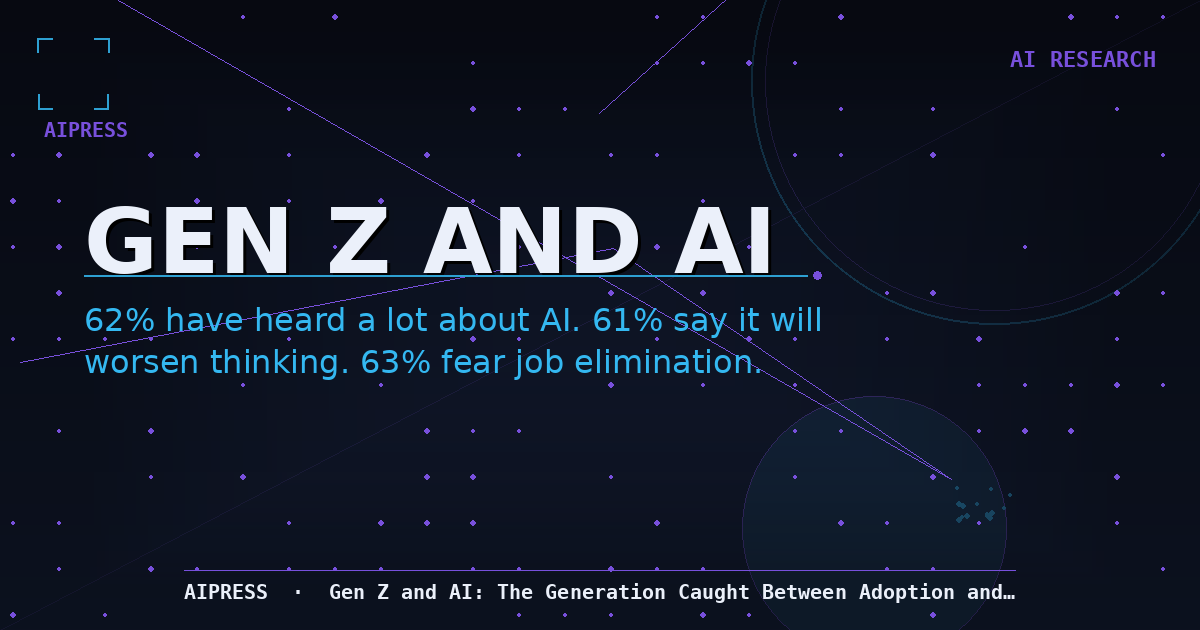
The clearest signal comes from Pew Research Center. In a September 2025 survey, 62% of adults under 30 said they had heard "a lot" about AI — the highest share of any age group. That is a striking figure on its own: the youngest adults are the most informed cohort about a technology that is still widely misunderstood in the broader population.
But the same survey produced a second figure that is, in context, more striking. Sixty-one percent of those under-30 respondents said AI would worsen people's ability to think and engage with information. In other words, the most AI-literate generation is also, by a wide margin, the most pessimistic about one of the technology's most-discussed cognitive risks.
A separate line of evidence comes from Gallup, Harvard Business Publishing, and the Walton Family Foundation, which in October 2025 surveyed a representative sample of nearly 2,500 U.S. adults between the ages of 18 and 28. That survey found that Gen Z uses generative AI frequently but wants significantly more guidance from schools and employers on how to use the tools properly — a finding that fits the same pattern: the generation is using AI, but it does not entirely trust itself to use it well, and it is looking for institutions to step in.
The jobs question is the one that keeps Gen Z up at night
The economic dimension is where the anxiety becomes concrete. Deloitte's 2025 Global Gen Z and Millennial Survey, the 14th edition of its annual study, gathered responses from more than 23,000 participants across 44 countries. The AI findings were stark.
Nearly two-thirds of Gen Z workers — 63% — said they worry that generative AI will eliminate jobs. A nearly identical share, 61%, worried that AI will make it harder for younger generations to enter the workforce. And 42% of Gen Zs reported that they already integrate generative AI tools into their daily work — meaning the generation most worried about AI taking jobs is also, in large numbers, already using AI to do those jobs.
A Deutsche Bank Research survey reported in September 2025 found an even more pointed figure: nearly one in five Gen Z workers — roughly 18% — said they were "very concerned" that AI would take their job within the next two years. That is a dramatically higher level of immediate, personal job-loss fear than older generations reported, and it lands in a labor market where entry-level roles are already being reshaped by automation.
The Deloitte survey also captured a structural shift in what Gen Z wants from work. These generations cited money, meaning, and well-being as the factors driving career decisions — and the stress and anxiety figures were high, with 46% of Gen Zs citing concern about their long-term financial future as a top contributor to stress. AI does not cause that financial anxiety in isolation, but it sits squarely inside it: a technology that threatens the entry-level rungs of the career ladder at the exact moment the generation most dependent on those rungs is trying to climb them.
What Gen Z is actually doing with AI
The "Gen Z is a chatbot native" story is only half true, and the half that is true is more nuanced than the headline.
Pew's February 2026 report on how teens use and view AI — based on a survey of 1,458 U.S. teens and their parents conducted in late September and early October 2025 — gave a more granular picture. The teen data showed that AI use is widespread but not universal, and that attitudes split along lines that are not purely generational. A good chunk of teens simply do not use generative AI regularly, and among those who do, the uses are pragmatic — homework help, idea generation, summarization — more often than social or companionship-oriented.
The Harvard Business Publishing / Gallup / Walton Family Foundation survey of 18-to-28-year-olds in October 2025 found a generation that has developed workable habits with AI but has not, by and large, been given a framework for them. The respondents were using AI, but they were looking to schools and employers for clearer guidance. That is a notable distance from the "Gen Z figured it out themselves" narrative.
Education: the homework-and-cheating story that keeps evolving
The education angle is where the Gen Z and AI story gets the messiest, and also where the data has moved fastest.
RAND released findings in March 2026 from its American Youth Panel showing that as of December 2025, 67% of students reported using AI to get answers for homework. Crucially, most of those students did not feel that their use of AI for school-related purposes constituted cheating — a finding that captures the generational shift in what "cheating" means when the tool is as ordinary as a chatbot.
The trajectory from Pew's earlier data is quick. In 2023, a Pew Research study found that 13% of American teenagers between the ages of 13 and 17 had used ChatGPT for homework. By 2024, that proportion had roughly doubled to 26%, according to a Frontiers in Education review. And by late 2025, the RAND figure of 67% suggests the number has kept climbing — though the exact comparisons across surveys are imperfect because the survey populations and definitions differ.
A July 2026 Fortune report drew on academic research to argue that AI is boosting homework scores while tanking exam performance — a finding that captures the central educational tension. The homework grade goes up because the chatbot does the homework; the exam grade goes down because the student did not learn the material. The University of Rochester economist John Singleton, a co-author of one of the studies cited, put the problem plainly: assigning short writing assignments to college students is, in his words, "insane these days, because you're going to get back 25 AI-generated short essays, and so it's really not gauging comprehension."
The UK student data adds another angle. The Higher Education Policy Institute's Student Generative AI Survey 2025, published in February 2025, found that the main factors putting students off using AI were being accused of cheating (53%) and getting false results or hallucinations (51%). A mere 15% were put off by the environmental impact of AI tools. The fear is not primarily ethical or ecological — it is practical and reputational.
Mental health and the platform layer
The mental health dimension of Gen Z and AI is distinct from the chatbot-therapy question covered in AIPress's earlier piece on AI and mental health. Here the question is broader: what does it do to a generation's sense of self, social life, and emotional baseline to come of age at the intersection of AI-generated content, algorithmically curated social platforms, and a constant stream of AI-generated media?
The numbers in this area are still mostly about social media rather than AI specifically, but the two are increasingly entangled. A Grow Therapy roundup of Gen Z mental health statistics published in June 2026 reported that 40% of Gen Z adults said they wish social media had never been invented — a figure from a 2024 Harris Poll. It also reported that 34% of Gen Z teens at least sometimes use social media as a resource to find mental health information.
Those figures set the stage for the AI layer. The same generation that is ambivalent about social media is now being offered AI companions, AI-generated influencers, AI-curated feeds, and AI-written content as a routine part of the platforms they already feel ambivalent about. The Pew data on AI pessimism — 61% saying AI will worsen people's ability to think — fits this context: a generation that has already seen what algorithmic content does to attention and mood is now watching a more powerful version of the same machinery arrive in conversational form.
A generation that is neither techno-utopian nor luddite
One of the more useful findings in the Gen Z and AI literature is that the generation does not fit the existing stereotypes. The "digital native" story suggests uncritical enthusiasm. The "endangered generation" story suggests uniform dread. The data supports neither.
Roughly half of teens, Gen Z, and millennials have not used AI in any sustained way, according to an April 2026 analysis in Persuasion, and many of those who have not used it do not trust it. At the same time, the Gallup/Harvard/Walton survey found a generation that is using AI often and wants more institutional support to use it well. The Deloitte figures show Gen Zs integrating AI into their daily work at a rate of 42% while simultaneously worrying at a rate of 63% that AI will eliminate jobs.
That is not contradiction for its own sake. It is what a generation looks like when it is living inside a technology transition that is simultaneously a tool, a threat, and a topic it has thought about more than any prior generation has.
What is still missing from the picture
A few honest caveats.
First, much of the most concrete data on Gen Z and AI is still recent — 2024, 2025, 2026 — which means the longitudinal picture is thin. We know how Gen Z thinks about AI right now; we know less about how that thinking changes as the technology changes.
Second, the survey populations are not perfectly comparable. Pew's teen survey, Pew's adult under-30 survey, the Gallup/Harvard/Walton survey of 18-to-28-year-olds, Deloitte's global 23,000-person survey, and the RAND American Youth Panel all ask different questions of different populations. The numbers are directionally consistent — high awareness, high ambivalence, high job anxiety — but the exact percentages should be read as signals, not as a single canonical dataset.
Third, the education data is moving targets. The jump from 13% of teens using ChatGPT for homework in 2023 to 26% in 2024 to 67% of students using AI for homework by late 2025 is a real trajectory, but the definition of "using AI for homework" ranges from "asked a chatbot for a summary" to "ran the entire assignment through a model," and the surveys do not always distinguish.
Fourth, the mental health side of the equation is still mostly indirect. The Gen Z mental health statistics available are largely about social media and general well-being, not about AI specifically. That is a gap, and it is a significant one given that AI is increasingly woven into the same platforms the existing data is about.
Who is most affected
Within Gen Z, the AI effect is not evenly distributed.
- Students in formal education. The RAND and Pew numbers on homework use are the most concrete evidence that AI has already changed the educational experience of this generation in a way that is not yet fully understood. The homework-grade-up, exam-grade-down pattern is a real phenomenon, and it is concentrated in exactly the population that is still building the foundational knowledge the exams are supposed to measure.
- Young workers in entry-level roles. The Deloitte and Deutsche Bank figures — 63% worrying about job elimination, 61% worrying about workforce entry, nearly one in five very concerned about losing their job within two years — point to a generation whose career start is happening inside an automation wave. That is a structurally different situation from prior generations entering the workforce.
- Young people already struggling with mental health. The Grow Therapy figure — 34% of Gen Z teens using social media to find mental health information — plus the Pew ambivalence data suggest that the generation most likely to seek mental health support online is also the generation most exposed to AI-generated content, AI companions, and AI-curated feeds. The overlap is likely meaningful, but it is under-studied.
- Young people without institutional support. The Gallup/Harvard/Walton finding that Gen Z wants more guidance from schools and employers is, in context, a finding about a generation that is not getting enough of it. The students and workers who have clear guidance are in a different position from those who are left to figure it out themselves.
What to watch
Three things will define the Gen Z and AI story going forward.
One is whether the institutions Gen Z is asking for — schools, employers, policymakers — deliver guidance that is actually useful. The demand is documented. The supply is not.
Two is whether the education system adapts its assessment model faster than AI adapts to the assignment. The Singleton quote — "insane these days" — is a real-time signal that the Higher Ed model is already behind. Whether that gap closes or widens will shape an entire cohort's relationship to learning.
Three is whether the job-entry anxiety the Deloitte and Deutsche Bank surveys captured becomes a self-fulfilling prophecy. If employers automate entry-level roles faster than they create new ones, and if Gen Z's fear of those roles being eliminated becomes a reason to pull back from career investment, the economic part of this story becomes a feedback loop. The data does not show that happening yet. It shows the precondition.
The bottom line
Gen Z is the most AI-aware generation in history and, by a number of measures, the one most uncertain about what AI is doing to thinking, work, and learning. The generation is using the tools — for homework, for work, for everyday tasks — at high rates, and it is also, at high rates, worried that those tools will make it harder to think, harder to get a job, and harder to enter the workforce. The institutions this generation is looking to for guidance are, by and large, not yet providing it. The data is recent and still accumulating. What is already clear is that Gen Z is not living inside the AI transition as a passive audience. It is living inside it as a participant that has noticed the risks and is waiting, with some justification, for the adults to catch up.
Related AIPress coverage: How AI Is Reshaping Mental Health: Chatbots, Therapy, and the Anxiety Gap — the broader AI-and-mental-health evidence base this generation is living inside; AI Safety Evaluators Are Building a Business — and Experts Say the Current Model Won't Keep Them Independent — the institutional-response question Gen Z is waiting on, in a different domain.
Sources: Pew Research Center, "How Teens Use and View AI" (February 2026, survey of 1,458 U.S. teens and parents, Sept 25–Oct 9, 2025); Pew Research Center, September 2025 survey of adults under 30 on AI awareness and pessimism (reported July 2026 by Brookings); Gallup, Harvard Business Publishing, and Walton Family Foundation survey of nearly 2,500 U.S. adults aged 18–28 (October 2025, reported February 2026); Deloitte 2025 Global Gen Z and Millennial Survey — 14th edition, 23,000+ participants across 44 countries (May 2025, reported June 2026); Deutsche Bank Research survey on Gen Z job-loss anxiety (reported September 2025 by Fortune); RAND American Youth Panel findings on student AI use for homework, December 2025 (reported March 2026); Pew Research Center 2023 study on teens' use of ChatGPT for homework; Frontiers in Education review on homework in the AI era (June 2025); Fortune report on AI boosting homework scores and tanking exam performance (July 2026); University of Rochester economist John Singleton, quoted in The 74 (July 2026); HEPI Student Generative AI Survey 2025 (February 2025); Grow Therapy roundup of Gen Z mental health statistics (June 2026), citing Harris Poll 2024 and related data; Persuasion analysis of Gen Z AI usage and trust (April 2026).