AI and Working-Class Jobs: Automation, Wage Pressure, and the Divide No One Is Talking About
The AI and working class conversation skips the working class
Most of the public AI conversation is, whether it means to be or not, a white-collar conversation. The headline questions are about knowledge workers, software engineers, analysts, writers, and the entry-level office roles that generative AI can plausibly do some version of. That framing is not wrong — those are real and significant effects — but it is incomplete. The working-class dimension of AI is different in mechanism, different in timeline, and in some ways more consequential for the people it affects, because the safety nets are thinner and the alternatives are fewer.
The working-class story is not primarily about chatbots writing essays. It is about three things: automation of routine physical and clerical tasks, wage pressure at the bottom of the earnings distribution, and a labor-force participation decline that predates generative AI but is now intersecting with it in ways the data is only beginning to show.
The wage data is newer — and it is not good for low earners
The most significant recent contribution to this question comes from a July 2026 Apollo whitepaper on the impact of AI on the U.S. labor market, which used observed usage data from the Anthropic Economic Index rather than the theoretical exposure measures that dominate most prior work. That distinction matters: observed usage is a better proxy for what AI is actually doing in workplaces than occupational exposure scores, which are largely estimates.
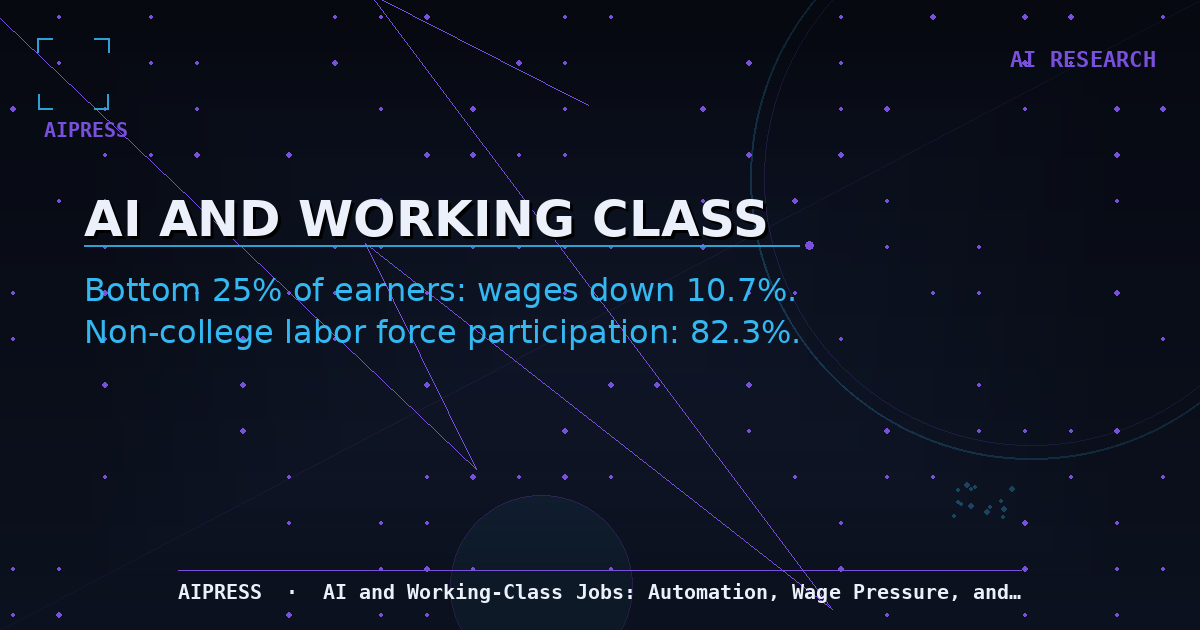
The Apollo paper's central finding is blunt. Workers in occupations with high AI exposure had real wage growth that was 6.7 percentage points lower than that of workers in low-exposure fields after 2023, the first full year after ChatGPT's rollout. And the effect was not distributed evenly across the income distribution: AI cut most into the wage growth of the lowest earners. Service workers saw an average 24.3% decline in earnings growth since 2023. Workers in the bottom 25% of earners saw wages decline by 10.7% over that same period.
Those are large numbers for a two-and-a-half-year window, and they point in a direction that complicates the "AI will create more jobs than it destroys" narrative that dominates the optimistic version of this story. The optimistic narrative is about aggregate employment levels — the question of whether there will be jobs. The Apollo data is about wages — the question of what those jobs pay. Those are not the same thing, and a generation of workers can be technically employed and still see their earning power decline.
Axios covered the Apollo findings in late July 2026 under the headline that captured the shift in the conversation: "AI's real threat to jobs could be lower pay." Business Insider ran a similar framing. The throughline is consistent: the near-term AI effect on the working class may be less about mass unemployment and more about wage suppression in the occupations most exposed to automation of the routine components of the work.
The employment numbers tell a slower, quieter story
Wage effects and employment effects operate on different timelines, and the employment data is more preliminary. The Dallas Federal Reserve reported in February 2026 that employment had declined by about 1% since late 2022 in the 10% of sectors most exposed to AI, using an exposure index developed by economists Edward Felten, Manav Raj, and Robert Seamans. One percent over three-plus years is not a mass-displacement figure, but it is a measurable decline concentrated in exactly the sectors you would expect — and it is early data in a transition that is still in its first act.
The Dallas Fed also published a separate analysis in January 2026 looking at young workers specifically, finding that employment drops in occupations with high AI exposure. That finding connects the working-class question to the Gen Z question covered in the companion piece in this series: young workers in exposed roles face a double hit, both the wage pressure and the entry-level opportunity pressure, at the same time.
The Bureau of Labor Statistics has begun explicitly factoring AI into its employment projections, as covered by BLS in August 2026. The BLS process now researches and analyzes the expected impact of AI and emerging technologies across about 800 detailed occupations for each 10-year projections cycle. The fact that the agency has moved AI from a footnote to a formal input in its projections is itself a signal: this is no longer a speculative concern in the official statistics.
The McKinsey numbers: long-run occupation-level displacement
The most cited long-run occupation-level projections still come from McKinsey's 2024 automation research, and they remain the benchmark against which newer data is compared. McKinsey estimated that the demand for clerks could plummet by 1.6 million positions, while retail workers, administrative assistants, and cashiers could face losses of 830,000, 710,000, and 630,000 jobs respectively.
Those are large occupation-level figures, and they are concentrated in exactly the working-class categories that the aggregate "AI will not replace most jobs" headline tends to gloss over. Cashiers, retail workers, clerks, and administrative assistants are not software engineers. They are not in the "AI will augment my knowledge work" bucket. They are in the "the routine parts of my job are increasingly automatable" bucket, which is a different and more threatening category.
Forbes covered this dimension in October 2024 under the headline "How AI Could Be Detrimental to Low-Wage Workers," noting that the McKinsey projections pointed to substantial losses in precisely the lower-wage occupations. The article's framing — that AI could be detrimental to low-wage workers — has aged into the data rather than been contradicted by it.
The "trapped worker" problem
One of the more analytically useful concepts to emerge in the 2025–2026 literature is the "trapped worker" — a worker in an AI-exposed occupation who has fewer viable exit options than the aggregate data implies. The Bipartisan Policy Center explored this in an issue brief published in July 2026, drawing on the observed-usage data to distinguish between workers who are exposed to AI and workers who are exposed and trapped.
The distinction matters. A young cashier in a high-exposure occupation might have viable exits — other retail, hospitality, logistics — even if the cashier role itself is under pressure. An older worker in the same role, in the same geography, with the same skill set, may not. The BPC brief found that workers aged 16–24 face the highest AI exposure but the lowest trapped rate, at 46.9%, largely because many are in cashier roles that are highly exposed but have viable exits. The trapped-worker rate is higher for the cohorts above them — the workers for whom the exposed occupation is not a stepping stone but a destination, and the automation of that destination is not a nudge toward something else but a direct reduction in opportunity.
This is a more precise version of the working-class anxiety question. The aggregate "AI will displace X million jobs" framing flattens a heterogeneous reality. A 22-year-old cashier and a 52-year-old cashier in the same store are in the same AI-exposed occupation and in profoundly different personal situations. The data that matters is the second one.
Blue-collar work: not immune, but differently exposed
The blue-collar dimension of the working-class question is frequently misunderstood. The initial wave of AI — large language models, generative text and image, conversational agents — is primarily a white-collar and clerical technology. The Michigan Journal of Economics analyzed this distinction in March 2026, noting that workers in hands-on roles are not at immediate risk of displacement from LLMs, but that the long-term risk grows as the industry for agentic and physical AI expands.
That "but" is doing a lot of work. The autonomous vehicle pipeline, the growth of warehouse automation, the spread of robotic process automation in logistics, and the steadily improving capabilities of physical AI systems all point toward a longer-term exposure for blue-collar work that is real but not yet fully priced in. Demand Sage reported in July 2026 that the U.S. trucking industry could lose 1.5 million professional driving jobs by 2030 as autonomous vehicles advance — a figure that is a projection, not a current reality, but that is large enough to matter for the sectors and regions that depend on it.
Built In reported in August 2025 that as many as 40% of employers planned to use AI-based automation to trim their headcounts — a figure that cuts across the blue-collar/white-collar distinction because it is about employer intent rather than technology capability. The 40% figure is an employer-side signal: a large share of companies are actively planning to use automation to reduce labor, regardless of the specific occupational mix.
The Trump-era tariff environment that Built In referenced adds a complicating factor: when hiring is already cautious for trade-policy reasons, the incentives to automate are stronger, not weaker, because the labor alternative is more expensive and less predictable.
The long-term labor-force trend predates AI — but AI is now in the mix
One of the most important contextual numbers in this conversation comes from the Bureau of Labor Statistics, via SparkCo's analysis published in February 2026. Drawing on BLS Current Population Survey data, the analysis found that labor force participation rates for prime-age workers without a college degree had declined to 82.3% from 88.6% in 1990 — a decline of more than six percentage points over 35 years, reflecting displacement in routine occupations.
That decline predates generative AI by decades. It is driven by a combination of factors: the long-term decline of routine manufacturing and administrative work, the opioid and disability dynamics that have removed significant numbers of working-age adults from the labor force, and the ongoing erosion of the middle-skill ladder that used to connect workers without a four-year degree to stable middle-income careers.
What AI changes is the pace and the mechanism. The BLS decline is a slow, 35-year story. The Apollo wage data is a fast, post-2023 story. The McKinsey occupation projections are a 10-year horizon story. A worker without a college degree is now living in the intersection of all three: a long-term structural decline in the availability of stable work without a degree, a recent acceleration in wage pressure at the bottom of the distribution, and an automation pipeline that is still in its early stages.
That intersection is the working-class AI story. It is less dramatic than the "AI will take all the jobs" version, and it is also less reversible.
Who gets the upside — and the honest finding that it might be the low-skilled
The most counterintuitive finding in the recent literature is the July 2026 Stanford study reported under the headline "Lower-skilled workers could earn more in an AI world." The research found that as AI simplifies job tasks, the biggest wage gains may go to workers who currently earn the least — a finding that runs against the "AI widens inequality" assumption and suggests that AI's effect on the wage distribution may be more complex than a simple top-heavy displacement model.
The mechanism is plausible: if AI reduces the premium on specialized skills that currently command higher wages, the relative position of lower-skilled workers could improve even if absolute wage growth is still pressured by the demand-side effects documented by Apollo. The Stanford finding and the Apollo finding are not necessarily contradictory — they are measuring different things. Apollo is measuring real wage growth since 2023, and the bottom quartile saw a decline. Stanford is measuring the potential distributional shift if the skill premium compresses. Both can be true: the near-term reality is wage pressure for low earners, and the longer-term possibility is that the compression of the skill premium changes the shape of the distribution in ways that could benefit the bottom.
The honest reading is that this is an open question with real stakes, and the data that will answer it is still accumulating. The Apollo data is the most recent and most empirically grounded on the near-term question, and it does not support optimism about low-earner wages in the 2023–2026 window. The Stanford finding is the most interesting on the structural question, and it is too early to know whether it will hold.
The geography of the working-class AI effect
The working-class AI effect is also a geographic effect, though the data on this is still developing. The occupations most exposed to AI — cashiers, retail salespersons, clerks, administrative assistants, truck drivers — are not evenly distributed across the country. They are concentrated in specific industries, specific regions, and specific types of communities. The communities that depend on a local employer in an AI-exposed sector face a concentrated risk that the aggregate national data does not show.
The Dallas Fed's young-worker analysis, the BPC trapped-worker analysis, and the BLS occupational projections all point in the direction of geographic concentration, even if they do not always say so explicitly. A 1% employment decline in the 10% most AI-exposed sectors is a national figure. The local effect in a town where the biggest employer is in that 10% is a different number.
What is still not well understood
A few honest caveats on the working-class data.
First, the wage data from Apollo is new — July 2026 — and it is based on observed AI usage, which is a better proxy than exposure scores but still a proxy. The 6.7 percentage-point gap and the 24.3% decline in service-worker earnings growth are large effects in a short window, and they warrant replication and extension before they are treated as settled.
Second, the McKinsey occupation-level projections are from 2024 and are based on automation potential, not observed displacement. The gap between "this occupation could be automated" and "this occupation has been automated" is where the real story lives, and it is not yet fully measured.
Third, the "trapped worker" concept is analytically useful but still a framework, not a robust dataset. The BPC figure of 46.9% trapped rate for young workers is a single data point in a developing literature.
Fourth, the Stanford finding that lower-skilled workers could see the biggest gains is the most interesting and least tested result in the recent literature. It deserves to be watched closely, because if it holds it changes the politics and the policy response to the AI labor question significantly.
Fifth, the blue-collar exposure timeline is real but still in the future. The autonomous vehicle projections, the warehouse automation trends, and the physical AI advances all point toward a longer-term blue-collar exposure that is not yet in the employment data. That makes it easy to dismiss and hard to plan for.
Who is most affected
Within the working class, the AI effect is concentrated in a few categories.
- Service workers in routine customer-facing roles. The Apollo figure — 24.3% decline in earnings growth for service workers since 2023 — is the most direct evidence that AI is already affecting this group, not just threatening to. Cashiers, retail workers, food service workers, and similar roles are in the first wave of the wage effect.
- Clerical and administrative workers. The McKinsey projections — 1.6 million clerks, 710,000 administrative assistants — point to a category that is AI-exposed in both the white-collar and working-class sense. These are not high-wage roles, and they are not insulated from the automation pipeline.
- Transportation and logistics workers. The 1.5 million trucking jobs projection by 2030 is a long-horizon figure, but it is large, and it is concentrated in a group — professional drivers — that has historically had limited alternative employment options in the regions where the jobs are concentrated.
- Workers without a college degree, generally. The BLS labor-force participation decline — from 88.6% in 1990 to 82.3% now — is the long-term context. AI is not the cause of that decline, but it is now a factor in it, and the mechanism is the erosion of the routine middle-skill roles that used to be the ladder for this group.
- Older workers in exposed roles with limited exit options. The "trapped worker" concept is most relevant here. The younger workers in the same roles may have exits. The older workers may not, and the automation of their role is a direct reduction in opportunity rather than a nudge toward something else.
What to watch
Three things will define the working-class AI story over the next few years.
One is whether the Apollo wage effect holds and extends. The 2023–2026 window is short, and the 6.7 percentage-point gap and the service-worker decline are large enough that if they persist, they will show up in the broader income distribution data in ways that are hard to ignore. If they are a short-run adjustment effect that fades, the story changes.
Two is whether the blue-collar physical AI timeline accelerates. The autonomous vehicle and warehouse automation projections are long-horizon, but the pace of capability gains in physical AI is not linear, and a faster-than-expected advance in the relevant technologies would pull the blue-collar exposure forward in time. That would change a "prepare for the 2030s" story into a "this is happening now" story for some communities.
Three is whether the policy response catches up to the distributional reality. The AI labor conversation has been dominated, for good reason, by the aggregate employment question — will there be jobs? The Apollo data suggests the more urgent question for the working class may be the wage question — what do the available jobs pay? A policy response built around the first question will miss the second.
The bottom line
The working-class effects of AI are real, measurable, and in some ways more consequential than the white-collar effects that dominate the public conversation — not because they are larger in aggregate, but because they are more concentrated, the affected workers have fewer alternatives, and the safety nets are thinner. The Apollo data on wage pressure at the bottom of the earnings distribution is the most important new piece of evidence, and it points to a wage effect that is hitting low earners before it has shown up as a mass-employment effect. The McKinsey occupation projections, the BLS labor-force decline, the Dallas Fed exposure data, and the BPC trapped-worker analysis all point in the same direction: the working-class AI story is not a future hypothetical. Parts of it are already here, and the parts that are still coming are large enough to matter.
The honest caveat is that the data is new and the picture is still forming. The Stanford finding that lower-skilled workers could see the biggest gains is a genuine counterweight to the pessimism, and it deserves to be tested rather than dismissed. But the near-term evidence, as of late 2026, favors the wage-pressure reading over the broad-based-upside reading, and that is a finding with real consequences for the generation of working-class workers currently in the exposed occupations.
Related AIPress coverage: Gen Z and AI: The Generation Caught Between Adoption and Dread — the younger-cohort angle on the same labor anxiety, with the Deloitte and Deutsche Bank figures; AI Safety Evaluators Are Building a Business — and Experts Say the Current Model Won't Keep Them Independent — the institutional-response question whose absence the Apollo data implicitly flags for the working-class dimension.
Sources: Apollo Global Management whitepaper, "The Impact of AI on the U.S. Labor Market" (July 2026, using observed usage data from the Anthropic Economic Index); Axios, "AI's real threat to jobs could be lower pay" (July 31, 2026), covering the Apollo findings; Business Insider, "AI Could Lower Workers' Pay More Than It Cuts Jobs" (July 30, 2026); Dallas Federal Reserve, "AI is simultaneously aiding and replacing workers, wage data suggest" (February 24, 2026), reporting the Felten–Raj–Seamans occupational exposure index and the 1% employment decline in the 10% most AI-exposed sectors since late 2022; Dallas Federal Reserve, "Young workers' employment drops in occupations with high AI exposure" (January 6, 2026); U.S. Bureau of Labor Statistics, "AI impacts in BLS employment projections" (The Economics Daily, 2025) and "Artificial Intelligence (AI) impacts on employment projections" (August 27, 2026); McKinsey 2024 automation research, as reported by multiple outlets including Forbes ("How AI Could Be Detrimental to Low-Wage Workers," October 28, 2024) and Final Round AI (July 3, 2026); Demand Sage, "81 AI Job Replacement Statistics 2026," reporting the U.S. trucking industry projection of 1.5 million professional driving jobs at risk by 2030; Built In, "The Rise of Blue-Collar Work in the Age of AI" (August 26, 2025), reporting the 40% of employers planning AI-based headcount reduction; SparkCo analysis of BLS Current Population Survey data on labor force participation for prime-age workers without a college degree (February 23, 2026); Bipartisan Policy Center, "Trapped Workers: Who AI Leaves Behind" (July 23, 2026); Michigan Journal of Economics, University of Michigan, "AI on the Job Industry: How Blue-Collar and White-Collar Workers Are Impacted" (March 13, 2026), citing Stafford 2025; Stanford University news office, "Lower-skilled workers could earn more in an AI world" (July 9, 2026).