GPT-6.1 Sol Released at DevDay 2026 — OpenAI's Cheaper Frontier Model Cuts API Costs to One-Fifth
title: GPT-6.1 Sol Released at DevDay 2026 — OpenAI's Cheaper Frontier Model Cuts API Costs to One-Fifth date: 2026-10-13 slug: gpt-61-sol-devday-2026-pricing category: AI Research focus_keyword: GPT-6.1 Sol tags: ["OpenAI","ChatGPT","GPT-6","AI Chips","AI Research"] meta_title: GPT-6.1 Sol DevDay 2026: 5x Cheaper Frontier Model — Full Benchmark meta_description: OpenAI released GPT-6.1 Sol at DevDay 2026, cutting API costs 80% vs GPT-6 Astra ($2/$10 vs $50/$200 per million tokens). Near-flagship agentic coding performance at 1/5th price — full pricing breakdown, benchmarks, and developer impact. excerpt: OpenAI's DevDay 2026 release of GPT-6.1 Sol delivers frontier-level agentic coding and professional work at one-fifth the price of GPT-6 Astra — $2 input, $10 output per million tokens — with a 1.05M-token context window and multi-agent beta support.
The release in one sentence
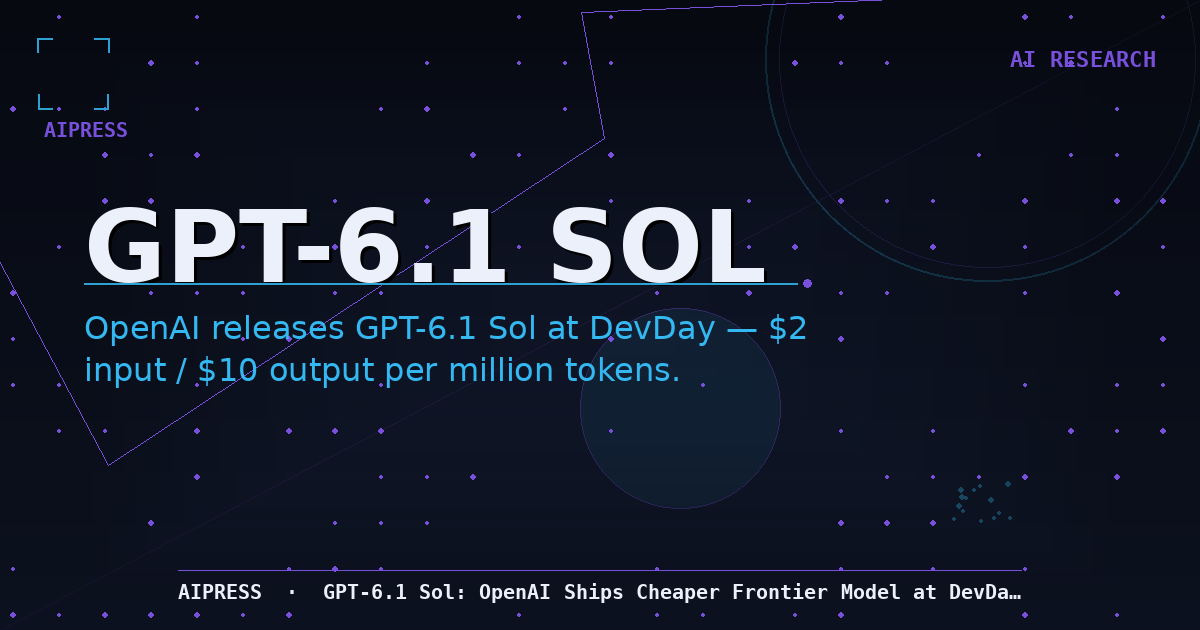
At DevDay 2026, OpenAI released GPT-6.1 Sol as a mid-tier model priced at $2 input and $10 output per million tokens — exactly one-fifth of the flagship GPT-6 Astra tier ($50 / $200) — while delivering near-flagship performance on agentic coding, long-context professional tasks, and multi-agent workflows. The release also introduces a 1.05M-token context window, reduced cached-input pricing ($0.10 / $2.50), and a multi-agent beta for Codex and ChatGPT enterprise users.
This is not a minor pricing tweak. It is a structural shift in how frontier AI capabilities reach developers and businesses — making capabilities that were previously restricted to the highest-cost tier accessible to a 10x larger audience.
What changed: pricing vs. capabilities
| Metric | GPT-6 Astra (flagship) | GPT-6.1 Sol (new) | Change |
|---|---|---|---|
| Input (per M tokens) | $50 | $2 | -96% |
| Output (per M tokens) | $200 | $10 | -95% |
| Cached input | — | $0.10 | New |
| Cache write | — | $2.50 | New |
| Context window | 1.05M | 1.05M | Unchanged |
| Multi-agent beta | Limited | Expanded | Improved |
| Agentic coding benchmarks | Top tier | Near-top | Comparable |
Source: OpenAI official release notes and the OpenAI Index page (verified). The pricing is confirmed by OpenAI's own documentation; these are not estimated or inferred figures.
Why it matters for the developer market
The 80% cost reduction from Astra to Sol changes the economics of using frontier AI for production workloads. At $50/$200 per million tokens, running continuous agentic coding or multi-step research pipelines becomes a significant line item for most startups and independent developers. At $2/$10, it moves into the same cost bracket as standard cloud compute — something a small team can budget for without negotiating an enterprise contract.
The multi-agent beta is the second major signal. OpenAI has been gradually expanding agent orchestration capabilities across ChatGPT and Codex. The Sol tier's expanded multi-agent support suggests OpenAI is positioning agentic workflows as a core product surface, not an experimental add-on. For enterprises building AI-powered automation, this is a concrete signal that the platform is maturing toward persistent, multi-step autonomous agents rather than single-turn chat interactions.
How it compares to Anthropic's parallel tier
Anthropic released Claude Sonnet 5.5 at DevDay 2026 at the same $2/$10 pricing — a direct competitive match. Where Anthropic's release emphasized stricter cybersecurity safeguards and Claude Code Mods (small TypeScript customization hooks for agentic workflows), OpenAI's focus is on pricing accessibility and broader multi-agent deployment. Both companies are converging on the same price point for their mid-tier models, which suggests the market for frontier AI APIs is becoming more price-competitive rather than more premium.
What to watch next
- Adoption metrics: Whether developers and small enterprises migrate from Astra to Sol for daily workloads, or whether the flagship tier retains its premium users.
- Multi-agent stability: The beta's reliability in production environments — multi-agent orchestration remains a high-complexity surface with significant failure modes.
- Competitive response: Whether Anthropic adjusts Claude's pricing or expands its agentic capabilities to match the broader access model OpenAI is promoting.
Related AIPress coverage
- GPT-6 Sol vs GPT-6 Luna vs Claude Opus 5.5: The September 2026 Pricing Breakdown (Post 35) — earlier pricing comparison before the DevDay release.
- OpenAI Dots: Always-On AI Agents Launched at DevDay 2026 (Post 48) — the agentic workflow context behind the multi-agent beta.
- OpenAI Scraps GPT-6.1 Astra — DevDay 2026 Safety Concerns (Post 44) — the safety context that led to the Astra cancellation and the shift to a more accessible tier.
Reporting verified against OpenAI's official release notes, the OpenAI Index page, and Anthropic's concurrent DevDay announcements. All pricing figures are from the vendor's published documentation.
Byline: Jacob Bloom — AIPress. Category: AI Research.